
Manta Point (Karang Makassar): How the Cleaning Station Works

admin
July 31, 2026
10 min read
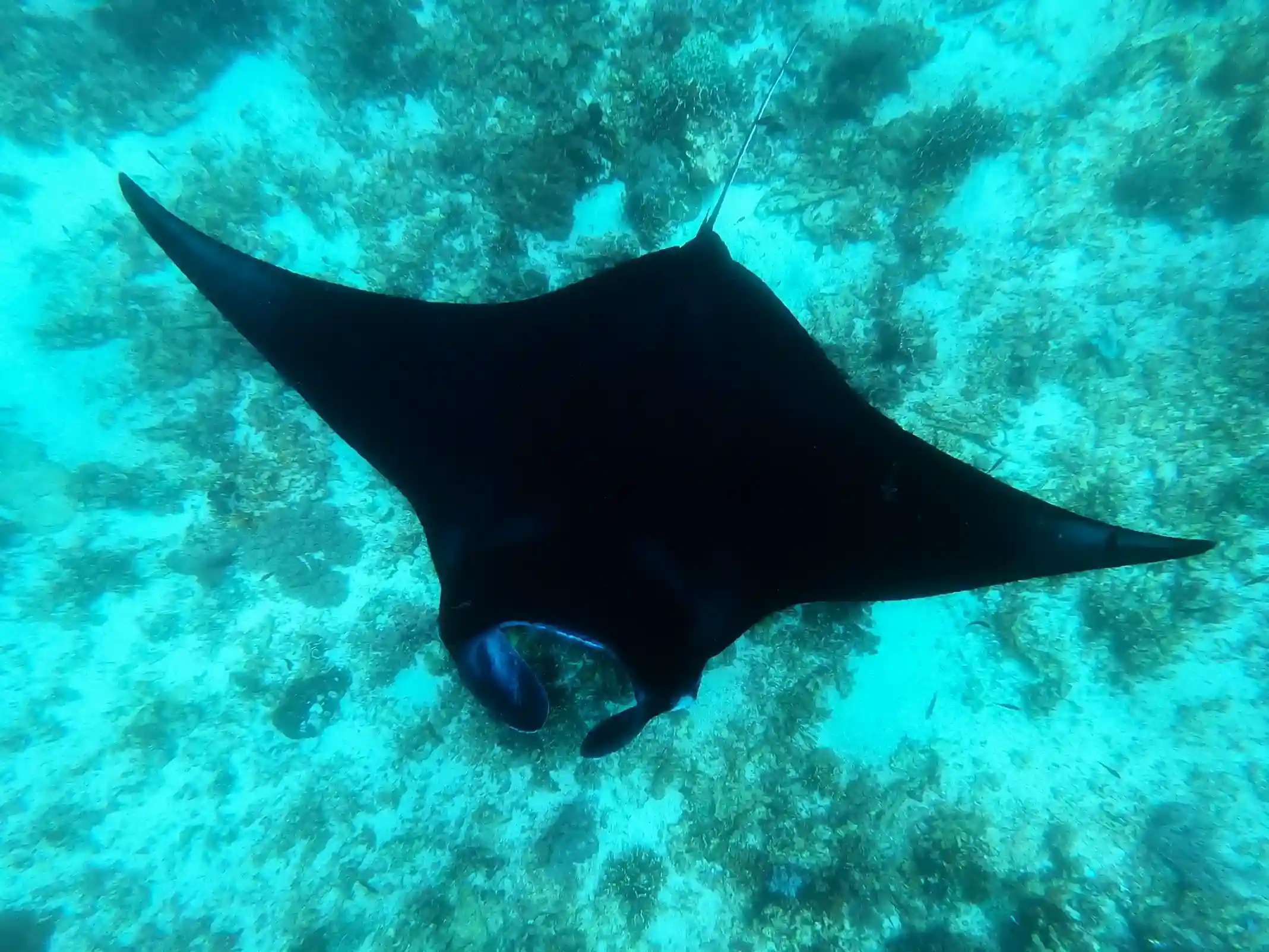
Short answer. Manta Point at Karang Makassar is a shallow drift over a reef where manta rays queue at cleaning stations to have parasites removed by cleaner wrasse. Mantas are present year-round in Komodo, with the strongest southern-site odds between December and March.
What is a manta cleaning station?
Karang Makassar is a long, low ridge of coral rubble in the channel between Komodo Island and the eastern islands. Two things happen there. Current pushes plankton along the ridge, so mantas feed. And specific coral bommies along it host cleaner wrasse and other small fish that pick parasites, dead skin and wounds off larger animals — the cleaning stations.
A manta arriving at one slows down and holds almost stationary above the coral head, sometimes rolling gently, while the cleaners work. That is why the site is so reliable for encounters: the animals have a reason to stay in one place rather than pass through. It also explains the single most important rule of the site — if you crowd the bommie, the manta leaves, and nobody sees anything.
What are you actually looking at?
| Feature | Reef manta (Mobula alfredi) | Oceanic manta (Mobula birostris) |
|---|---|---|
| Typical wingspan | Commonly around 3–4 m, up to roughly 5 m | Larger, reaching around 7 m |
| Where you meet them | The usual visitor at Komodo’s coastal cleaning stations | Occasional, in deeper open water |
| Feeding | Filter feeder on plankton | Filter feeder on plankton |
| Behaviour at the site | Cleaning passes, barrel rolls when feeding | Passing, less station-bound |
| Risk to swimmers | None. No sting, no teeth of consequence | None |
Mantas have individual belly-spot patterns, which is how researchers identify returning animals. If you get a clean photograph of the underside, it is genuinely useful data — several Indonesian manta ID projects accept submissions.
How does the snorkel actually work?
This is a drift, not a swim-around. The tender drops you up-current of the ridge, you float face-down and let the water carry you along it, and the tender picks you up down-current. You are not fighting anything; expending energy is the mistake. Kick only to steer.
Practical points our crew brief before you enter:
- Enter fast and together. A strung-out group in current is hard to collect.
- Do not chase. Hold your position and let the animal come to you. It very often does.
- Keep clear distance — broadly three metres or more — and never above and directly on top of a manta at a cleaning station.
- Never touch. The mucus layer on the skin is an immune barrier; a hand on it causes real harm.
- No flash. It achieves nothing at that distance and disturbs the animals.
- Stay off the reef. Karang Makassar’s rubble is fragile and shallower than it looks.
Visibility here is often not the postcard blue you get at the pinnacles, and that is a feature rather than a fault: plankton is why the mantas came. Green, soupy water at Karang Makassar is usually good news.
Divers versus snorkellers — who gets the better encounter?
Different, not better. Snorkellers get the wide top-down view: a manta lifting toward the surface with the sun behind it is the image most people take home, and it happens at the surface. Divers get duration and eye-level behaviour — sitting still on sand at the edge of a station, watching a queue form, staying with it for forty minutes.
Because the site is shallow and current-driven, it suits divers with some current experience. It is not in the same category as the strong-current pinnacles such as Batu Bolong, Castle Rock and Crystal Rock, which we treat as advanced sites. Snorkellers with no dive certificate lose very little here, which is why the site anchors our non-diver snorkelling itinerary.
When are your odds best?
Mantas are in Komodo all year. The pattern to know is seasonal emphasis rather than presence and absence. From December to March the wet-season plankton bloom in the southern part of the park raises the odds at southern sites such as Manta Alley considerably — this is the counterintuitive reason experienced guests deliberately book the “wrong” season. From April to October the seas are calmer, visibility is better overall, and Karang Makassar in the centre of the park does the work.
The month-by-month picture, including sea state and crowding alongside manta odds, is laid out in our month-by-month guide to the best time for a Komodo liveaboard.
When do we swap sites?
Karang Makassar is the default, but it is not the only option. If current is running too hard for a safe snorkel drift, if the site is crowded with day boats, or if the season points south, the captain may substitute Manta Alley in the south or Mawan between Komodo and the eastern islands. Occasionally the answer is simply to come back at the next tide. All of these are ordinary operational decisions and they are made on the water, not in advance.
What we will not do is promise a sighting. Nobody honest can. What we can do is put you on the right site at the right state of tide with a crew that knows the ridge — which is what our parent operator means by manta encounters in Komodo being managed rather than hoped for. If you want the whole day’s shape around this stop, see the stop-by-stop Yumana route.
Frequently asked questions
Are you guaranteed to see mantas at Manta Point?
No, and be sceptical of anyone who guarantees it. Karang Makassar is one of the most reliable manta sites in Indonesia, but these are wild animals. Multiple attempts across a multi-night sailing raise your odds far more than any single visit.
Can non-swimmers or weak swimmers do the manta drift?
With support, often yes. Wear a buoyancy aid, stay with a crew member, and use the floating line. If current is strong on the day, our crew may advise you to sit that particular drop out and take the next, calmer stop instead.
Are manta rays dangerous?
No. Mantas have no stinging barb and do not bite. The risk at the site is boat traffic and current, not the animals — which is why you stay in the briefed area and keep the tender in sight.
What is the best month for mantas in Komodo?
Mantas are present year-round. December to March raises the odds at the southern sites because of the plankton bloom, while April to October gives calmer conditions and better general visibility at central sites like Karang Makassar.
How close can you get to a manta?
Keep roughly three metres or more, never position yourself directly above one at a cleaning station, and never touch. Hold still and they routinely close the distance themselves.
Do I need a dive certificate to see mantas here?
No. Karang Makassar is a shallow drift and snorkellers get excellent encounters, often the best photographs of the trip. Diving adds time in the water rather than better access.
Planning your Komodo sailing?
Yumana Liveaboard is a 32-metre wooden phinisi operated by Komodo Luxury out of Labuan Bajo. Send your dates and headcount and you will get live availability, the cabins still open and a written quote — no deposit needed to ask.
WhatsApp +62 811 3823 875 · Email sales@komodoluxury.com