
Pink Beach Komodo: Why It Is Pink and What to Do There

admin
July 31, 2026
10 min read
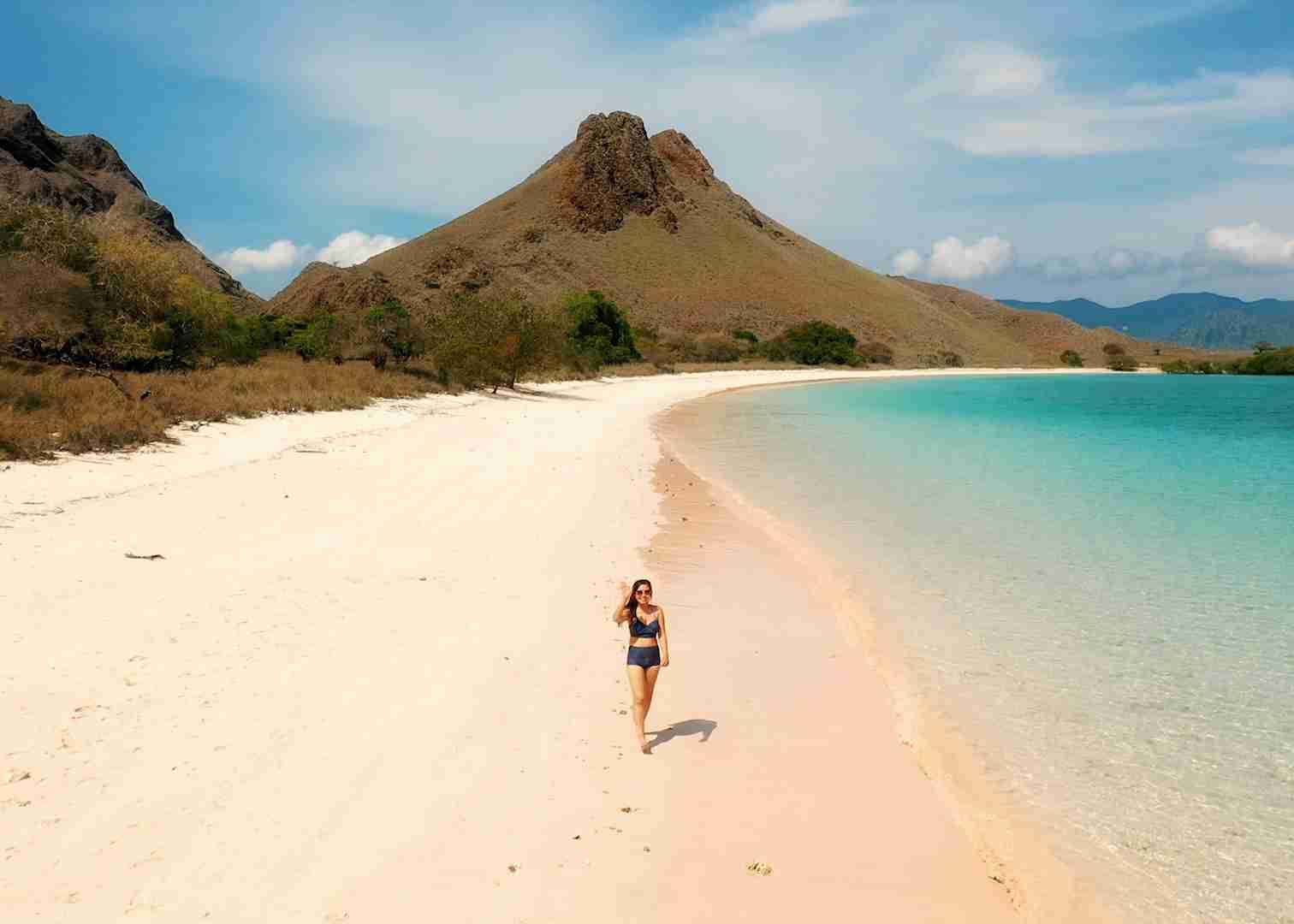
Short answer. Pink Beach — Pantai Merah — is pink because fragments of a red-shelled organism, Homotrema rubrum, wash out of the reef and mix with white coral sand. The colour is strongest at the waterline, in bright midday light, and after fresh surf has turned the sand over.
Why is Pink Beach actually pink?
The pigment is biological, not mineral. Homotrema rubrum is a tiny reef-dwelling foraminiferan that builds a hard red calcareous shell. When those shells break down on the reef in front of the beach, the red fragments are carried ashore and folded into ordinary white carbonate sand. The result is a sand that reads pale cream from a distance and clearly rose-coloured at the wet edge where the grains are packed and saturated.
This is the same mechanism behind pink beaches in Bermuda and parts of the Bahamas, and it explains most of the disappointment people report. If you arrive at low light, stand ten metres up the dry beach and look down, you will see beige. Walk to the waterline, crouch, and pick up a handful, and you will see the red fragments plainly.
When does it look most pink?
| Condition | Effect on colour | Practical takeaway |
|---|---|---|
| Wet sand at the waterline | Strongest colour | Photograph the wet edge, not the dry back-beach |
| High, bright sun (roughly 10:00–14:00) | Maximum contrast against turquoise water | Midday is genuinely the best light here, unusually |
| After a period of surf | Fresh fragments turned to the surface | Colour varies week to week; it is not a fixed thing |
| Overcast or late afternoon | Muted, closer to cream | Still a good snorkel stop, weaker photograph |
There is more than one pink beach inside Komodo National Park. The best known sits on the eastern side of Komodo Island; there are smaller pink-sand pockets elsewhere on the same coast and near Padar. Which one your boat uses on the day depends on wind, swell and how busy the main anchorage is.
What is the snorkelling like?
Better than most people expect, and the main reason to stay rather than photograph and leave. The reef starts close to shore — often within fifteen or twenty metres of the sand — and drops from ankle depth over a shallow shelf into a slope in the five-to-fifteen-metre range. That shelf holds hard coral, staghorn thickets, anemones with clownfish, parrotfish grazing audibly, and frequently turtles working the edge.
Current at Pink Beach is usually mild compared with the drift sites further north, which makes it one of the more forgiving snorkel stops on the route and a sensible place for nervous swimmers to start. It is not, however, currentless: when the tide runs, the water along the reef edge moves parallel to shore. Enter up-current, drift back toward the tender, and keep the boat in view. Our crew swims with guests and puts a floating line and rings in the water on request — the same support described on our page for the snorkelling-only Komodo cruise built for non-divers.
Wear something over your torso. Midday sun plus reflective water plus a shallow shelf is the classic recipe for a burnt back, and the sunburn people bring home from Komodo is almost always earned at a beach stop rather than at sea.
How crowded does it get?
Pink Beach is on every day-trip itinerary out of Labuan Bajo, which means a reliable rush from mid-morning to early afternoon as speedboats and day boats converge. Liveaboard guests get the good windows at either end: an early call before the fleet arrives, or a late-afternoon stop once it has gone.
Our route puts Pink Beach into the sequence at whichever end of the day gives the quieter anchorage, which sometimes means visiting it directly after the dragon trek rather than at the classic hour. The hour-by-hour logic is set out in our Komodo itinerary broken down stop by stop.
What are the rules at Pink Beach?
- Take no sand. This one is not a suggestion. Removing pink sand is prohibited, it is checked, and at scale it is the single biggest threat to the thing you came to see.
- Take no shells or coral, alive or dead. Dead coral rubble is where the next generation of reef settles.
- Do not stand on the reef. Fin over the shelf; put your feet down only on sand.
- Reef-safe sunscreen, applied on the boat well before you get in, not on the beach.
- Carry your rubbish back to the tender, including fruit skins. There is no bin, and there is no collection.
How does Pink Beach fit into a Yumana sailing?
Every one of our Komodo routes includes it, including the shortest. On the 3D2N open trip aboard Yumana it usually falls on the middle day between the dragon trek and the manta stop, when everyone is already in and out of the water and the tender routine is running smoothly. Guests who have already been in the water at Karang Makassar tend to treat Pink Beach as the relaxed one — a swim, a walk to the headland, a long look at the sand.
If you want to understand how the beach connects to the wider reef system you will be snorkelling all week, our guide to how the Manta Point cleaning station works covers the current-driven other half of the picture. For the beaches and bays across our wider operating area, see our parent operator’s overview of Komodo beach stops.
Frequently asked questions
Is Pink Beach in Komodo really pink?
Yes, though it is a soft rose rather than the saturated pink of edited photographs. The colour comes from red Homotrema rubrum shell fragments mixed into white sand, and it is clearest at the wet waterline under high sun.
Can you swim and snorkel at Pink Beach?
Yes. The reef begins close to shore and holds hard coral, reef fish and frequently turtles. Current is usually gentle compared with the northern drift sites, which makes it one of the friendlier snorkel stops on the route.
Can I take pink sand home as a souvenir?
No. Removing sand, shells or coral from Komodo National Park is prohibited and checked. The beach only stays pink because the sand stays on it.
What is the best time of day to visit Pink Beach?
For colour and snorkelling visibility, late morning to early afternoon. For solitude, early morning or late afternoon when the day-trip fleet from Labuan Bajo is not there. Liveaboard schedules can take either window.
Is Pantai Merah the same as Pink Beach?
Yes. Pantai Merah is simply the Indonesian name, meaning red beach. Note that the park contains more than one pink-sand beach, so different operators may anchor at different ones depending on conditions.
Do I need water shoes?
Not for the sand, which is soft. They are useful if you plan to walk the rocky headland at either end of the bay, and some guests prefer them for entering the water over the shallow shelf.
Planning your Komodo sailing?
Yumana Liveaboard is a 32-metre wooden phinisi operated by Komodo Luxury out of Labuan Bajo. Send your dates and headcount and you will get live availability, the cabins still open and a written quote — no deposit needed to ask.
WhatsApp +62 811 3823 875 · Email sales@komodoluxury.com