
Kalong Island Sunset: Thousands of Flying Foxes, From the Deck

admin
July 31, 2026
9 min read
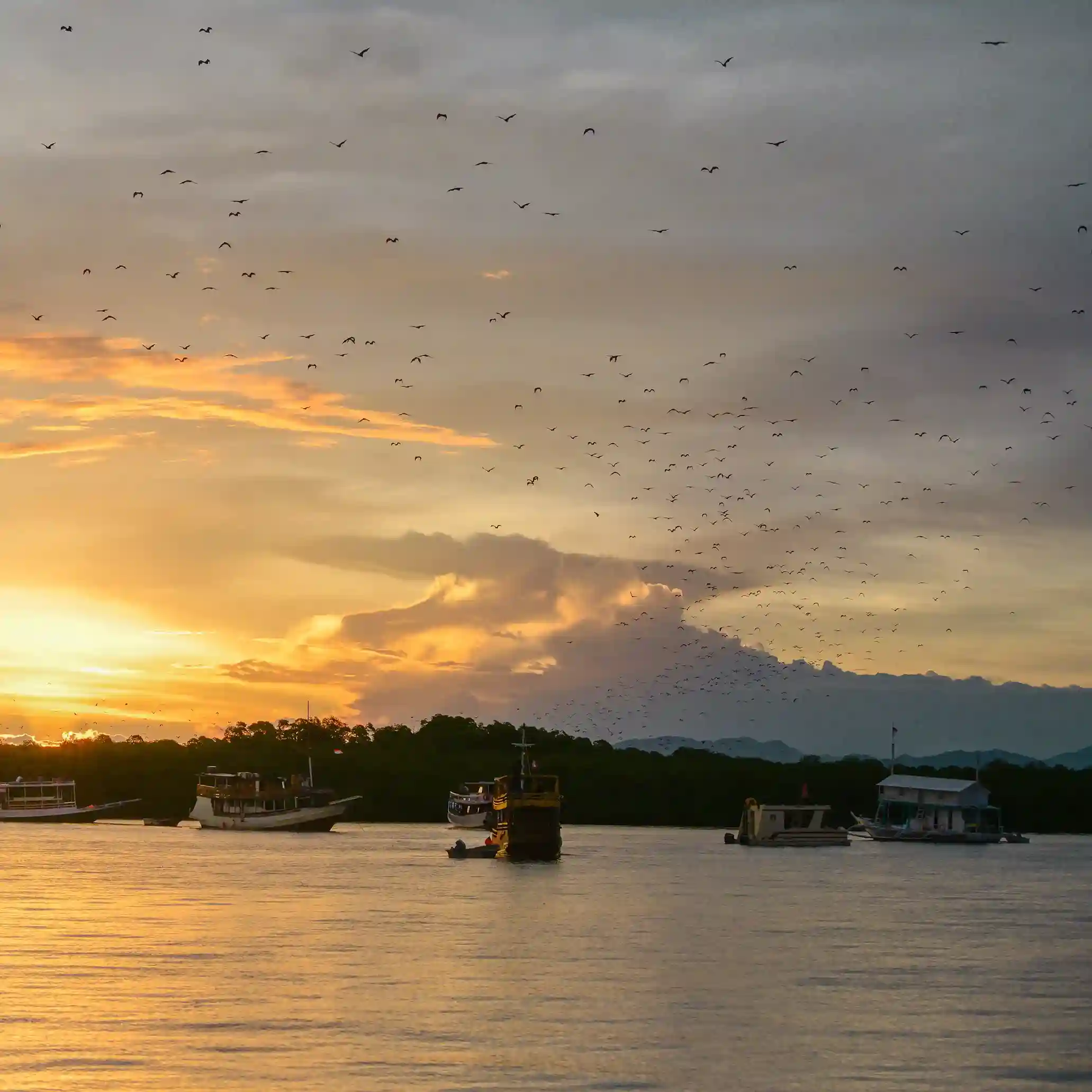
Short answer. At dusk, thousands of large fruit bats — flying foxes — lift out of the mangroves on Kalong Island and stream across the anchorage toward Flores to feed. You watch it from the deck of the boat with a drink in hand. There is no landing and no walking involved.
What actually happens at Kalong Island?
Kalong is the Indonesian word for flying fox, and the island is named for what lives in it. The mangroves along its shoreline hold a large colony of Pteropus fruit bats — big animals with wingspans well over a metre, no relation in behaviour to the small insect-eating bats most visitors picture.
Through the day they hang in the canopy, audible and visible if you look with binoculars: a restless dark mass in the mangrove tops. Then, in the twenty minutes or so around sunset, they leave. Not all at once but in a rolling exodus, first in ones and twos, then in a continuous ribbon that crosses the channel toward the fruiting trees of Flores. It goes on for a good half hour. Boats anchor a respectful distance off, engines down, and everyone stands on the sky deck and watches it happen overhead.
It is the quietest scheduled event of the whole trip and, in guest feedback, one of the two or three most remembered.
What time does it happen through the year?
| Period | Approximate sunset window | Notes |
|---|---|---|
| April–June | Around 17:45–18:00 | Calm seas, clean dusk light |
| July–September | Around 17:45–18:05 | Dry, dusty air can give strong colour |
| October–November | Around 17:50–18:10 | Transitional; some haze |
| December–March | Around 18:00–18:20 | Cloud more likely; departure still occurs |
Indonesia’s equatorial position means sunset moves within a narrow band rather than swinging by hours as it does in temperate latitudes. Treat these as planning windows, not timetables — the crew will call you up on the night. The bats depart in overcast weather too; heavy rain simply makes them later and harder to see.
Why do you stay on the boat?
Because landing is the wrong thing to do. A roosting colony is sensitive to disturbance, and repeated approaches push bats off a roost they depend on. Flying foxes are also significant seed dispersers and pollinators across this part of Indonesia — the forests either side of the channel are partly their work — and colonies elsewhere in the region have declined where they have been disturbed or hunted.
So: no landing, no lights pointed into the mangroves, no drone over the roost, no engines revved to make them fly. If they lift early because of a noisy boat, that boat has taken the show from everyone else and cost the colony energy it needed for the night’s feeding. Our crew anchors off and keeps deck lights low until the stream has passed.
How do you photograph it?
Honestly: it is hard, and the phone in your pocket will not do it. You have low light, moving subjects, and a deck that is itself moving. If you want to try:
- Shoot the silhouette against the sky rather than trying to light the animals. Expose for the sky and let the bats go black.
- Push ISO further than feels comfortable — 3200 to 6400 — and keep shutter speed at 1/500 s or faster to freeze wingbeats.
- Use a mid telephoto around 70–200 mm. Longer becomes unusable handheld on a moving deck.
- Forget the tripod. The boat’s motion defeats it; brace your elbows on the rail instead.
- Shoot early in the departure while there is still colour in the sky. Ten minutes later it is a lovely thing to watch and an impossible thing to photograph.
The alternative, which we quietly recommend, is to put the camera down and just watch. It is a thirty-minute natural event happening directly over your head, and there is a version of this trip where you spend all of it looking at a screen.
Where does Kalong sit in the sailing?
Kalong is an evening anchorage, so it doubles as the night stop. The pattern is: afternoon activity, anchor down at Kalong in late afternoon, sunset and bat departure from the sky deck, dinner served on board, then a quiet night at anchor before an early start. It is the calm hinge in the middle of a busy itinerary, and it is one of the reasons a liveaboard beats a day trip — a day boat is already halfway back to Labuan Bajo when this happens.
It appears on our multi-night routes; you can see where it lands in the sequence on the Yumana itinerary hour by hour, and how it fits the standard sailing in our 3D2N Komodo open trip. If sunset from the deck matters to you, it is worth knowing what the anchorage does to sleep and motion, which our guide to your first night aboard a phinisi covers in detail. Our parent operator’s notes on evening anchorages in the park explain how the same stop is scheduled across other vessels.
Frequently asked questions
What time do the bats leave Kalong Island?
Around sunset, typically between 17:45 and 18:20 depending on the month, with the main stream lasting roughly twenty to thirty minutes. The crew will call you up on deck shortly before it starts.
Can you land on Kalong Island?
No, and you should not want to. The colony is watched from the anchored boat to avoid disturbing the roost. Landing offers a worse view anyway — the departure passes overhead, not along the shore.
Are the flying foxes dangerous?
No. They are fruit-eating bats with no interest in people, and they pass well above the vessel. You are watching them, not interacting with them.
Do the bats come out in the rainy season?
Yes. The departure happens year-round because it is a feeding trip, not a seasonal event. Heavy cloud or rain delays and obscures it rather than cancelling it.
Is Kalong Island included on a 2D1N trip?
Not always. The shortest sailings prioritise Padar, the dragons and a snorkel stop, and the evening anchorage may be chosen for the next morning’s start instead. Ask us when you enquire if the sunset at Kalong is a priority for you.
How many bats are there?
Estimates run into the thousands and no reliable current census exists, so we do not publish a figure. What is certain is that the stream is continuous for a long time — you will lose count within the first minute.
Planning your Komodo sailing?
Yumana Liveaboard is a 32-metre wooden phinisi operated by Komodo Luxury out of Labuan Bajo. Send your dates and headcount and you will get live availability, the cabins still open and a written quote — no deposit needed to ask.
WhatsApp +62 811 3823 875 · Email sales@komodoluxury.com